

|
Chapter
7 Art and Craft in Ludham 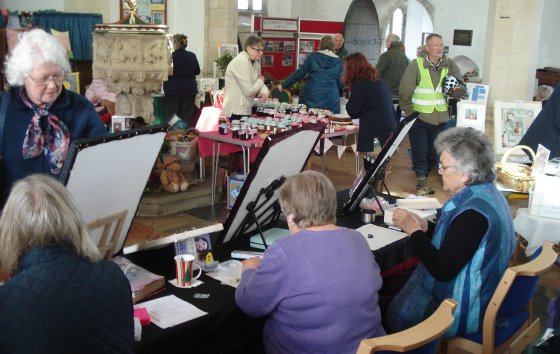 At the annual Ludham Craft Fair |
Over time, Ludham has attracted a variety of Artists to her bosom. Some have only been in the village a short time, others have made their home here and now in the 21st century we have a burgeoning young artist who loves the village and the Norfolk scenes on the doorstep.
What is it that has made these people want to put paint to canvas, pen to paper, hand to clay or simply live here? As Linda Matthews from Broad Sky Gallery at Ludham Bridge said ‘wherever you look there is inspiration to paint’. There are winter scenes, evocative and atmospheric marshland scenes, big Norfolk skies, water scenes and a never ending freedom and wildness that tantalise and encourage the artist to interpret and capture it on canvas. There is moodiness here, stillness at the end of the day, misty hollows and windswept marshes, history in the buildings and on the waterways, wildlife, people at work and leisure, and activity of one form or another everywhere you look.
The scenes change from day to day, season to season but the magical draw of the county of Norfolk never ceases. Actors, painters, sculptors, potters, photographers and authors have lived amongst us in our village.
Athlene Seyler and Nicholas ‘Beau’ Hannen
 |
From the world of film, stage and television, they were friends of Edward Seago and frequently visited The Dutch house where he lived. Athlene Seyler first appeared on stage in 1909 with her film debut being in 1921. She was well known for playing rather dotty ladies. Her film and television career lasted into the 1960s. She was president of The Royal Academy of Dramatic art (RADA) from 1950 and gained a CBE in 1959. Her husband Nicholas Hannen was from 1902 – 1905 an apprentice to the well known architect Edwin Lutyens but his acting career included about 50 stage plays and at least 26 films. He gained an OBE. They bought a house in Ludham, opposite the church, next to Church View where a mutual friend, the sculptor Hazel Kennedy lived. They came down for long periods in the summer and played an active part in village life. They were regular church-goers particularly to evensong at the time when Reverend Fred Smith was incumbent. After Nicholas Hannen died in the early 1970s, Athlene sold the house and moved back, permanently, to her house overlooking the river in London’s Chiswick Mall where she died aged 101 in 1990. |
Edward Seago
One of our best known artists was Edward Seago. Jane Seymour gives an account of Edward Seago Artist 1910 – 1974, resident of Ludham from 1947 to 1974. This painting is of The Dog Inn at Ludham Bridge.

Edward Seago was born in Norwich, the second son of Brian and Mabel Seago. He was to have very little formal education owing to a heart condition which was at that time, little known and untreatable. Much of his time was spent confined to his bed where he would study the cloud formations and paint the sky.
Contrary to his mother’s wishes he determined to become a painter. At the age of thirteen he was befriended by the Suffolk landscape painter, Bertram Priestman who gave him tuition and, more important still, encouragement to persevere.
The Seago family moved to Brooke Lodge in 1924 where despite frequent bouts of illness the fourteen year old boy learned to ride hard and later to fly and sail. His first exhibition of paintings was held in London when he was nineteen. It was during his teens that Ted left home and joined a travelling circus
which inspired many drawings and paintings about which he wrote and illustrated two books. In all he wrote nine books and collaborated with the then Poet Laureate, John Masefield, on two more.
After leaving the circus Seago spent time traveling with a ballet company and painting the dancers.
During the Second World War Ted became a camouflage officer but because of a serious recurrence of his heart problem he was invalided out of the Army. General Alexander, himself a keen painter, whom Seago knew well, took him to Italy in the final stages of the Campaign when Alexander was Allied Commander in Chief. There he painted, among other scenes of devastation, the ruins of Monte Catoni and Casino and a plethora of fine pen and wash drawings of the Allied Landings. We should also note that Seago provided the sculpture of "Pegasus" - the flying horse for inclusion in his designs of the insignia and badge for the British Airborne Forces, which they have kept to this day.
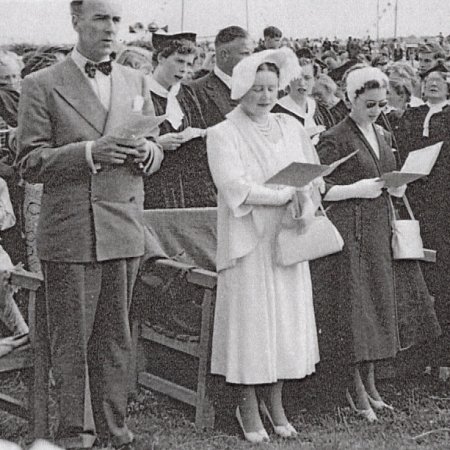
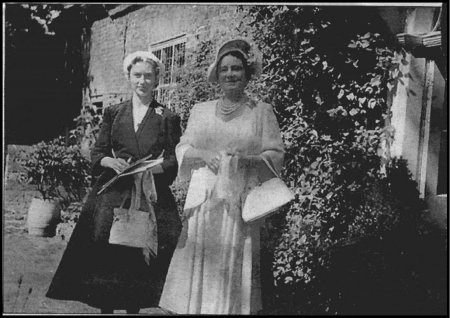 Above - Royalty were visitors at the Dutch House. Right - Seago at the annual St Benet's Abbey Service |
 |
It was in 1947 when, happening to drive past a lovely Dutch gabled seventeenth century house in Ludham, Seago made the unprecedented move of stopping the car and knocking on the door. He was to ask the owner, should the house ever be up for sale, could he be offered first refusal. A month later the owner died and Ted bought. He moved in shortly inheriting the bonus of Annie Thompson as cook and her brother Charlie as gardener. The downside to the otherwise happy outcome was that his family, from which he was trying to distance himself, bought Hall Common House next door six months later!
From that vantage point his over protective mother was able to keep a watchful eye on her son. Some two hundred acres of surrounding farm land was bought and managed between Brian and his two sons.
A studio was built at The Dutch House and with Charlie Thompson’s help the garden was created. Peter Seymour joined, a few years later, as Secretary and general factotum. He was to stay with Seago until his death in 1974.
A ‘white boat’ and a Wayfarer were kept at the bottom of the garden and a larger sea going vessel was moored at Cold Harbour. Painting trips to the continent were undertaken from there with Peter Seymour and, sometimes, “Chillo” Mileham, who lived in Ludham, as crew.
Seago became close friends with the ‘Royals’, particularly with Queen Elizabeth the Queen Mother, who visited The Dutch House on the last day of her reign. The King, who was shooting at Sandringham that day, died in his sleep that night. Ted painted portraits of the King and Queen, the then Princess Elizabeth and Princess Margaret. In 1952 he was one of twelve artists invited to record the Coronation. In 1956 he accompanied Prince Philip with others on a voyage to Antarctica for two months – one of the few occasions when he could bear to leave The Dutch House.
In 1969 Ted acquired a property in Sardinia and gave his sea going yacht, Capricorn, to the Sea Scouts in London. It was in Sardinia in 1973 that his final illness manifested itself. He was operated on out there for a brain tumour. He survived the operation and was flown to a London hospital. However, by the autumn it was manifestly obvious he was dying. His one wish was to be able to return to The Dutch House but, sadly, this was not to be. He died in London on January 19th 1974, was cremated in Norwich and his ashes scattered over the marshes where he had loved to paint.
A retrospective exhibition of his work was held in Kings Lynn in August 1974. A biography by Jean Goodman was published in 1978 and two books on his art were written, one by Ron Ranson, the other, a definitive and scholarly work by James Reid in 1991. A television documentary, “Light out of the Sky” was made for Anglia Television in 1989. Exhibitions of Seago’s work are held regularly, mostly in London.
Brenda and Noel Dennis
 |
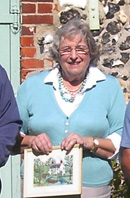
Brenda Dennis went to Bromley Art
College where, as part of the course, she was
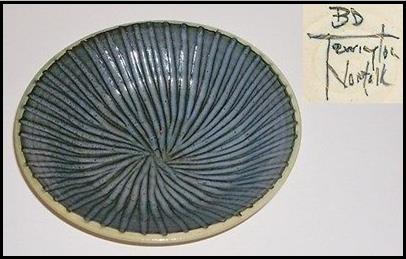
introduced to the art of pottery. Having passed her Intermediate exams, she applied for and was given a job at Henry Watson’s Potteries at Wattisfield in Suffolk in 1951. She worked as a potter and designer until 1952 when she married and went to live in Terrington St. Clement where, once the electricity supply was connected in 1957, Terrington Pottery started as a hobby and was sold on the premises. Later, much of her production was bought to be sold on to places in London, such as the General Trading Company, and Thomas Goode and also to outlets in the Cotswolds. Exhibitions were undertaken in Cambridge, Peterborough, King’s Lynn, Holt, Brancaster and Kelling until 1992 when Noel retired and they moved to Ludham. The equipment was moved and installed in the stable at Womack House and the trade-mark changed from BD to BDL. |
 |
Noel Dennis started designing and making Grandmother Clocks to pass the time in the winter months on the farm at Terrington St. Clement, and continued after retiring to Ludham. They are made from oak and mahogany with a standard pendulum movement with Westminster chimes and finished with the clock face of the clients own choosing, painted by Brenda Dennis.
Colin Burns
Colin Burns is a versatile artist with a wide range of subjects. From his earliest days his love of landscape and natural history has been an absorbing interest and the basis of most of his life’s work.
An entirely self taught artist with a natural talent Burns’ artistic career began in early childhood. Always sketching and painting by the age of 12 he was winning all his school’s art prizes and by 16 had sold his first painting.
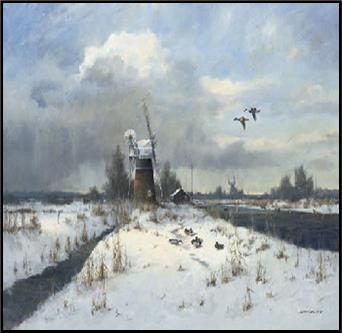
He was born in St. Olaves, Suffolk in June 1944 and by 1956 had moved house six times, coming to rest finally at West Farm, an isolated farmhouse on the marshes at West Caister. With stunning marshland views, huge Norfolk skies, glorious sunsets and an abundance of wildlife the young artist found himself in an environment that was to form the basis of and shape the major paintings produced throughout his life.
At eighteen, he acquired his first agent, C H Dyer & Son, who not only ran a fine art gallery but were expert picture restorers and framers. Harry Dyer was an early mentor for the young Burns and it was not long before he suggested that the artist, in whom he had great faith, should take some work to London and sell in the West End. The Tryon Gallery in Dover Street, W1 was suggested and an appointment made.
Aylmer Tryon was a big name in the London art trade. His gallery was known worldwide and it’s walls were covered with the works of the great and the good. The bird painters Archibald Thorburn, George Lodga and Peter Scott, the equestrian painters Alfred Munnings and Lionel Edwards and the newly successful David Shepherd and Robert Bateman were hung there. Aylmer Tyron accepted the two oil paintings, which were submitted and sold them within the week. A further twelve oils were commissioned for a future mixed exhibition. Duly delivered and put on show, all twelve paintings sold within the first hour of the opening and so began a twenty-five year relationship with the Tryon Gallery. Seven one-man shows and numerous mixed exhibitions were held in London over the years until in 1994 the gallery changed hands. It was also in 1994 that he moved to Ludham.
At this time another important move was made. The artists subject range was broadening. Landscape and natural history subjects now shared the easel with seascapes and beach scenes, continental subjects, still life and sporting art. A wider market was sought and found through the medium of the auction house. Christies sold their first Burns painting in 1995 and many more were to follow over the next 10 years in London and New York.
Colin Burns work is keenly sought after today as it was when he first began painting over 50 years ago and is included in many important private collections in both Europe and America.
Colin Burns work can be seen in Mandells Gallery Ltd., Norwich; Christies, annually in London and New York; Christies Scottish Sale, Edinburgh; Keys Auctioneers, Aylsham; Bearnes Auctioneers, Exeter. His work has been reproduced as Christmas Cards for over thirty years by The Norfolk Wildlife Trust of whom he is a keen supporter.
Martin Walton
Martin Walton was born in Birmingham on 27th September 1939. He started painting seriously in 1954, after coming top in art at his local grammar school. He then met a keen amateur painter who encouraged him and took him out painting landscapes on Sunday mornings. At about this time Martin discovered the paintings of Edward Seago through a library book. This fired his interest in the Norfolk landscape and as he was about to have a holiday with relations in Cromer he decided to write to Seago and see whether he could meet him.
 |
In August 1956 he was invited to spend a
day painting in Edward Seago’s studio. As the
weather was too bad to work outside, a still
life was set up for him to paint, whilst Seago
carried on with his own work there, giving
Martin occasional advice as they worked. In September 1956 Martin started as a student at the “Birmingham College of Arts and Crafts.” It was a very exciting time for him, especially meeting other students with an enthusiasm for art. After two years there the need to paint the Norfolk landscape became so strong that he took a short-term job, saved some money, and came to Ludham to paint. He lived with Bob and Hilda Burton at Manor View, on the Yarmouth Road. Every day he went out with his paints and easel to paint the local landscape, and from time to time would take some work to Edward Seago for criticism. The Billingtons, who took over the King’s Arms pub in 1959 suggested that Martin should show some of his paintings in the Lounge Bar there. This turned out to be a great success and provided him with a steady flow of sales. In fact, the first eight paintings were sold to a Suffolk farmer, whose son has subsequently bought a further seventeen! In 1962 Martin had his first of several exhibitions at The Assembly House in Norwich. This was very successful and generated a large number of sales. In the severe winter of 1962 - 1963 Martin moved to a cottage at Salthouse to paint another aspect of the Norfolk scenery, and in the spring he moved to Syleham in Suffolk, on the banks of the River Waveney …… an altogether gentler countryside. |
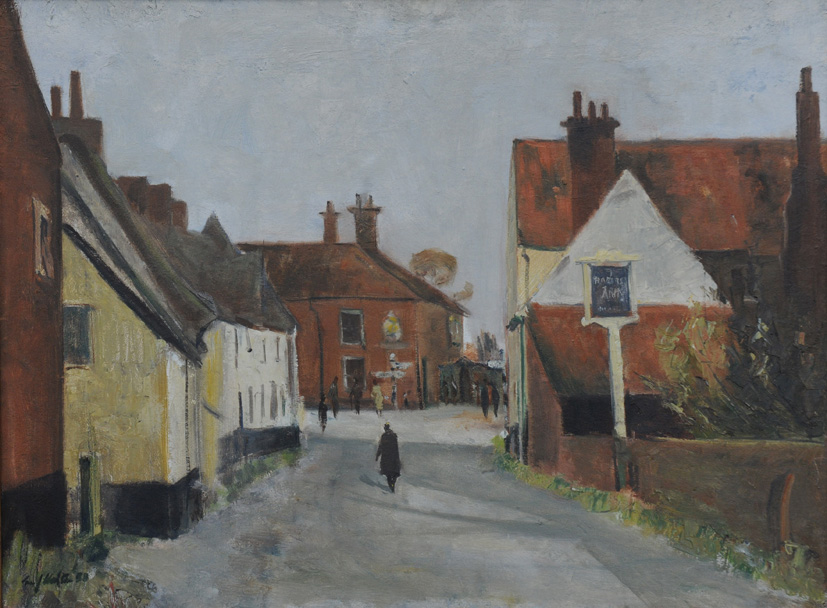
A Martin Walton painting of Yarmouth Road
In 1966 Martin decided that he needed to be more adventurous and break away from the more traditional way of working. He went and lived in London and whilst there exhibited some work in the Piccadilly Gallery in Cork Street. In 1969 he came back to Ludham and returned to landscape painting, searching for new ways to express himself through his work. Over the next few years his very vigorous style of abstract painting emerged. These are a far cry from his early work, but nevertheless, arrived through a study of the landscape. Recently he has had two large exhibitions at Blickling Hall, and one in Clerkenwell, London.
Martin’s deep concern with landscape has found expression in his involvement with the Ludham Society, and, for the last thirty years in the Campaign to Protect Rural England. This voluntary work has included a period of three years on the National Executive in London. He has also had a lifetime’s interest in architecture, and this has led to his work as a judge of the CPRE Awards for the last twenty years. This interest led to his designing part of the Pike’s Nursery development in Ludham, and the design of the conversion of his and Nancy’s house in Lovers’ Lane.
His work as an artist continues to explore new ideas and techniques. It could be said that he is very much “a painter’s painter".
Neil Smalley
| Neil Smalley was born in Sheffield in
1941 His art training, as such, had two
components. The first was a half day
master-class (at the age of nine) with a
professional artist, Fay Pomerance, who, instead
of telling him what a clever little boy he was,
told him exactly what was wrong (or right) with
everything he showed her. He absorbed it all,
and can recall a lot of what was said to this
day. The second component was seven years at grammar school under the highly skilful and perceptive tutelage of one Frederick Parsons – a good ol’ Norfolk boy. The syllabus included English architectural history, up to and including ‘A’ level (– 80% pass), which also proved to be a very valuable grounding for landscape painting. Grammar school was followed by seventeen years in architecture, interior design, shops, offices, pubs, houses, while heavily into amateur drama, which involved designing and painting scenery, designing lighting, costumes, make-up – all grist to a painter’s mill. |
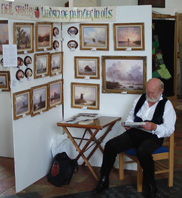 |
He moved to Norfolk in 1977 (broke and unemployed) to live on a small cruiser, to sell paintings to tourists. Twelve months later he bought the houseboat, ‘Walrus’ (ex landing craft) at Thurne, and discovered Ludham and Ludham Bridge.
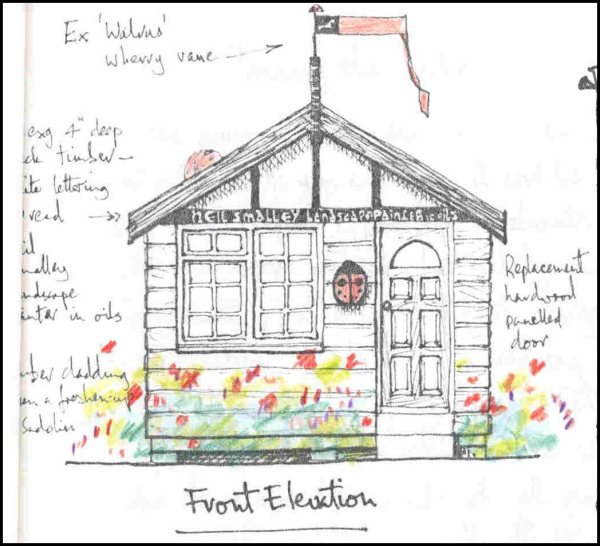
He married in 1980 (Valerie, from Harrogate) and continued living and working on the boat in the summer, and at Valerie’s house in the winter. The boat was turned into a lock-up (with the arrival of second child – Miriam in 1985, after John in 1982) and he moved to the house at Catfield. The boat was burgled in 1989 when paintings to the value of £3,500 were lost in the middle of the season. The boat was disposed of and a studio opened at Ludham Bridge in time for the 1990 season. This continued to the end of the century.
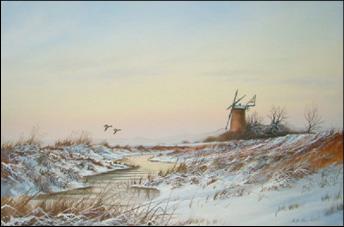
Neil Smalley describes his paintings as “traditional oil landscapes (some sea and snow and fantasy thrown in for fun), mainly wherries, windmills, wildlife and water-tourist fodder, but some with attitude, rain, wind, tide, mist, storm, sunshine, dawn and dusk. In fact, what you see in life is, hopefully, what you get in the paintings”.
Robert Chaplin
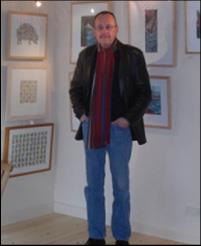 |
Robert studied Graphic Design at Great Yarmouth Art College, followed by a career in the advertising industry in London and Europe. After returning to Norfolk he was been able to develop his own unique style enabling him to capture scenes in a more graphical mood in keeping with his experience in the contemporary world. The Norfolk Broads and its surrounding landscapes inspired Robert to explore, develop and produce artwork in a new and exciting mode. Robert’s work was widely exhibited and he was also sponsored by the Arts Council for an exhibition on the River at Great Yarmouth and he was highly praised for his interpretation of the urban landscape. He worked in pastel, ink and crayon. He had a book of his work published. At various times, Robert’s work could be viewed at Garden Gallery, Southwold, Time and Tide Museum Cafe, Great Yarmouth, The Gallery at Horning, Church St. Gallery, Cromer, The C21 Shop, Mundesley and Paston House, Norwich. |
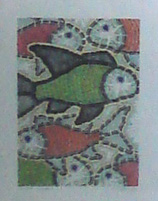 An example of Robert's Work
|
S.F. Clarke
 |
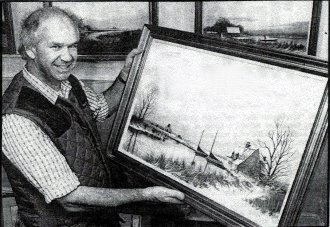
S. F. Clarke was born in 1939 at Staithe
Road Ludham. In 1946 the family moved to Fritton
Farm Ludham where there was no electricity,
water, sewerage or heating. "In the winter of 1947 the year of the big freeze, which lasted for seven weeks I would have been about seven years old. It was at this age when I started to have an interest in drawing and painting. I would use old Christmas cards and copy the scenes. I remember at this time sketching by a big open fire while my mother was making homemade bread and butter. After six years, I moved to Walton Hall Farm Ludham." |
 |
At Stalham School which I attended, I was encouraged by Mr. Sid Pestal the art teacher. I was the best pupil in his class and he helped me to nurture my natural talent by allowing me to use oil paints. In those days oil canvas was not available to me. One of my many jobs on the farm helping my father, was to feed the young calves with powdered milk. The milk came in gauze type cotton sacks and I would use these when they were empty. My mother would wash them then I would cut them to size and stretch them onto a board and use them for my oil paintings.
Picture clarke2.jpg
One day I was amazed when a sales rep came to the farm and saw one of my paintings on the cotton sacks which had been supplied by his firm. He was also amazed that I had produced a painting on the sack, and he bought it from me. It was my first sale at the age of fourteen years.
In 1965 I moved to Hickling and met Roland Green (the wildlife artist) who was very encouraging to me. I was invited to show my work at various art exhibitions in and around Hickling and North Walsham and this is where I had some of my first serious sales.
I moved to Grove Farm at Catfield in 1971. It was here I started to use watercolour paint which I found was successful, and this gave me another medium to work with which I enjoyed immensely. My work started to sell very well, encouraging me to spend more time, mostly evenings (after working on the family farm all day) in a spare room in the farmhouse.
As time went on my work was more in demand so I exhibited at the Assembly Rooms in Norwich on several occasions. I remember on one of my preview nights people were queuing to come in and my paintings were selling like hot cakes.
Three years later I was invited to exhibit at the Tudor Gallery in Norwich where the exhibition proved to be a great success. How Hill is another venue where I had two successful one-man shows.
There was an opportunity in 1993 for me to have my own art gallery through the farm diversification scheme. The gallery was launched as Grove Farm Studio and Gallery and was opened on April 25th. by the Euro MP Paul Howell.
David V. Jones
David was born in Luton and attended Luton Art College. After being de-mobbed from the army he
worked as a cartographer, drawing maps at Rothamstead Experimental Station in Harpenden for 14 years until becoming art editor for the “Home Gardener” magazine, and later, for “Motor Caravan”, commuting every day to London.
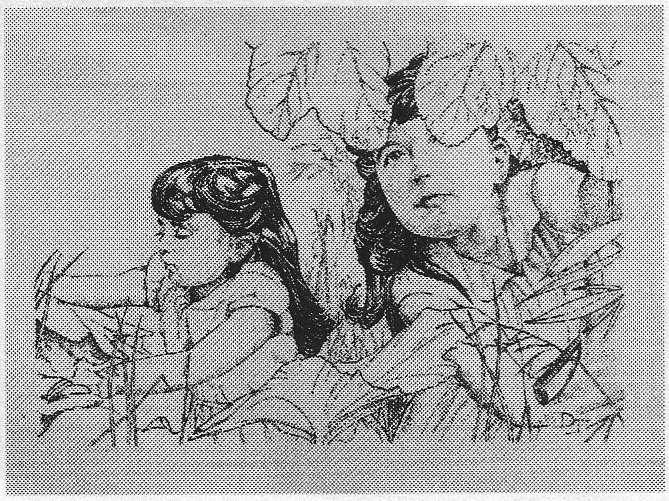
He then freelanced from home until his retirement, still producing regular work for the “Home Gardener” and the “Readers Digest” gardening book among others. He also, at this time, formed a strong connection with D. C. Thomson (Scotland) producing masses of scripts and drawings for their comics and girls’ magazines (Judy, Diana, The Dandy, Sparky). This was fulfilling a dream that he had had since childhood. He moved to Ludham in 1969 while still freelancing until his retirement, and died in 1992.
William Mervyn
 |
William Mervyn was born in 1912 in Nairobi. He acted in films and television, including the bishop in “All Gas and Gaters”, the friendly old gentlman in “The Railway Children”, “A Conflict Of Wings”, and several “Carry On” films. He lived in Ludham at Folly House from the 1960’s until he died in 1976. |
Frank Hankin
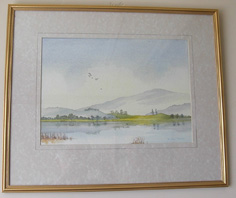 |
Frank was born in 1921 in Grimsby. He first went to sea at the age of 6 with his father who was owner/skipper of a fishing trawler. At the age of 16, he left school and joined the Royal Navy. In the war he was one of only 19 survivors out of 121 when the ship Daffodil was torpedoed or mined. He then served in various merchant ships before joining the “Belfast” in 1948 and went out to China. He came to Ludham in 1971 with his wife Ellen, where, after several moves, they ended up at 14 School Close. Frank paints in oils, watercolours and pastels. In the main, his subjects are mainly landscapes. |
 |