
 |
A
History of St Catherine's Church
|

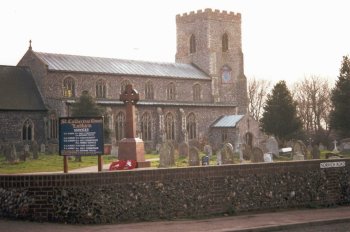 |
This history was
written by Ken Grapes, the Fabric Officer at
St Catherine's |
Many visitors to Ludham are surprised at the size of its beautiful old church. This reflects the great wealth of the population when it was built during the 14th and 15th centuries, replacing an older, smaller and far less impressive structure. Nobody knows when the first church was established in Ludham but it is well known that Christianity existed during the Roman Occupation and that, with the major immigration of Angles and Saxons in the mid 5th Century, this religion was not entirely lost to the pagan hordes. St Augustine arrived at Canterbury from Rome in 597 and converted the Anglo Saxon King Aethelbert; the new religion spread and was well established in East Anglia by 680, when the area was divided into 'sees', the northern (Norfolk) one being at North Elmham. Much later the See was transferred to Thetford and, during Norman times, to Norwich, where it remains.
The next two Centuries saw internal strife between the Anglo Saxon Kingdoms until their eclipse by the powerful Vikings. In 865 a great Viking army occupied East Anglia and over the next 150 years the raiding Vikings gained control of a large part of the North and East of England. (Called the Danelaw). This division of England was confirmed in 1017 when the Dane Cnut (Canute) became King.
By this time most of the Scandinavians had also been converted to Christianity so it is not surprising that Cnut had created the Abbey of St Benet at Holm near Ludham in 1016. This was the first Benedictine Abbey in Norfolk and he subsequently endowed it with the manors of Ludham, Horning, and Neatishead. This turn of events had ramifications which are still current today and which are discussed next.
It is known that a church of some kind existed in Ludham in the early 1lth Century as it is mentioned in a charter from Edward the Confessor thought to be dated around 1047. This church, probably of wood and thatch, was originally a rectory until, in 1220, the church revenues were appropriated to St Benet's Abbey. This meant that the Abbot became rector and appointed a vicar. The Parish of St Catherine still has a vicar because of this. St Benet's Abbey was never dissolved during the Tudor Reformation. Instead, Henry VIII appointed the last Abbot to be Bishop of Norwich and, by act of parliament, took the Bishop's revenues and lands to himself and granted the Abbey and its possessions to the bishopric. The Bishop of Norwich remains Abbot of St Benets to this day. These two events had important implications for Ludham church:
1. The present Chancel is on the site of the original 11th Century building which was the 'monastic' church. Responsibility for the maintenance of this part of the church has devolved upon the Church Commissioners and not the parish!
2. The Bishop of Norwich remains Abbot of St Benet's and is, therefore, and highly unusually, both rector and patron of the Ludham living. There is a board in the church with a list of all vicars from 1318.
3. The Abbey owned a large home farm built in 1450 and now called Ludham Hall. This later became the country seat of the Bishops of Norwich. Bishop Samuel Harsnett spent much time here and was a great benefactor of the parish. In 1619 he gave the church one of its ring of five bells.
To return to the chronological story.
The 12th and 13th Centuries saw some highly significant events including the Norman Conquest and the production of the famous Domesday Book which records the many large flocks of sheep in Norfolk. During the 12th century the digging of the rich deposits of peat for use as fuel began -which eventually resulted in the creation of the Norfolk Broads. The so-called Hundred Years War with France began in 1339 and the Black Death reached England 10 years later. The peasants' revolt in 1381 indicated that not all were benefiting from the prosperity engendered by the flourishing wool trade.
Despite all this turbulence, the 14th Century saw the flowering of Norfolk Churches and this was when the present Ludham Church was built, almost certainly, from the wealth of the nearby Abbey which had achieved great prominence and riches. Of the 14th Century flint and stone church, only the tower and chancel remain. The nave was rebuilt some 100 years later, on about the same footprint, in early perpendicular style with a tall clerestory carried on arcades with octagonal pillars and with a splendid hammerbeam roof. A truly lovely screen was erected in the Church in 1493, possibly as a "finishing touch" to the new nave.
|
The Roof
 This
very
fine
hammer beam roof is made from oak and in every
other spandrel, has got the wheel of St. Catherine
carved into the wood.
|
|
The Rood Screen
|


During the next century, The battle of Agincourt (1415), the burning of Joan of Arc in Orleans and the Wars of the Roses all seem to have passed rural Norfolk by. Ludham's 14th Century church with its lofty l5th Century nave was however affected by events after the accession of the Tudors in 1485. In his Act of Supremacy, King Henry VIII began the Reformation by asserting his control over the English Church and the dissolution of the monasteries was soon in full force. (But not, as mentioned above, St Benet's Abbey!) Henry's successor Edward V1 turned up the reformatory heat. Until that time the chancel arch carried a large beam supporting a 'rood' or crucifixion -a carving of Christ on the cross, accessed by a small staircase in the wall. The King's commissioners decreed that all roods and other images be removed, and it was. There is no record as to what became of it.
Edward was succeeded by his half sister Mary -a devout Catholic who promptly set about reversing the reformation. One can quite imagine the minor panic which ensued - in Ludham the village carpenter produced boards to be fitted in place of the rood and this, called a tympanum, was painted with a scene of Christ on the cross. The painter must have been a local as it is very unsophisticated compared with those on the screen below, which were painted some 65 years earlier.
Mary's reign was brief. After only five years she was succeeded in 1558 by Queen Elizabeth 1- back to Protestantism. More panic! What to do? The Vicar and wardens were obviously of a pragmatic mind because they covered the painted crucifixion with a canvas bearing the arms of Queen Elizabeth with, in latin, the inscription 'I am not ashamed of Christ's gospel. Long live Queen Elizabeth' !
There followed the long and glorious years of Elizabeth's reign with Drakes' historic attempt at voyaging around the world, the defeat of the Spanish Armada and the execution of Mary Queen of Scots - none of which seem to have left much mark on rural Norfolk. However, by the beginning of the 17th Century, Puritanism was beginning to speak with a powerful voice, in both spiritual and political affairs. So far as the chancel fabric is concerned, Puritanism put the finishing touches to the destruction begun by Henry VIII and carried on during the reign of his son, Edward VI.
Norfolk had, for a variety of reasons, largely supported the parliament side during the Civil Wars of the Commonwealth period. Perhaps this is why so many beautiful screens, including that of Ludham, survived the general desecration. There must have been a certain amount of fright, as both painted canvas arms of Elizabeth and the painted boards were taken down from the tympanum arch. Boards were rolled in canvas and hidden in the staircase up to the former rood - which was then bricked up and concealed.
The restoration of the monarchy, with the accession of Charles 11 in 1660 began a long period of general decline and neglect of many country churches as the attention of the government focussed on more pressing political matters. The rural backwater of Ludham was not much affected by the great fire of London (1666) Monmouth's rebellion crushed at the battle of Sedgemore (1685) nor by the War of the Spanish Succession and the suppression of the Scottish Jacobites in the mid 18th century. The French revolution and the Napoleonic wars saw many sons of Norfolk called to the service of their country including Norfolk born Admiral Lord Nelson whose great victory at Trafalgar in 1805 gave Britain command of the seas. There were few events of note in Ludham until the time of Queen Victoria (1837-1901). A party from the Norfolk Archeological Society visited the church in 1879 and discovered the bricked up rood staircase. Therein still lay the boards with the painted crucifixion wrapped in the canvas painting of the Arms of Queen Elizabeth. These were put back in the tympanum arch, with the canvas on the altar side, at a major restoration of the church in 1890.
|
The royal coat of
arms and Crucifixion Painting.
|


The church survived World War II, although many were the air attacks on the nearby RAF airfield and Army camp. In 1969 the screen and tympanum painting were restored.
During 2004 the lead on the roof has been recast, the stone mullions and the lead glazed windows refurbished and the gutters, drains and soakaways replaced. The tower roof has been restored and designs produced to install a kitchen and a toilet in the base of the tower. The lighting has been replaced and plans laid for the new heating. The Church Architect has now reported that the high level clerestory windows must be repaired as they are buckled and leak onto the congregation below. This repair will necessitate a full scaffolding of the inside of the church and this will also be used to re-decorate the interior - not done for a great many years. Needless to say, donations towards this work would be gratefully received.
There is a donations form at the bottom of this page..
St Catherine's has stood in the centre of Ludham for some six Centuries, providing inspiration for the village and watching over the births, marriages and deaths of its inhabitants. Long may it continue.
You really should come and see this lovely old building and its many fascinating contents for yourself.
The Pews The present pews are Victorian |
The Organ We bought it in 1933 |
The Lady Chapel With stained glass window and a "squint" to allow a view into the Chancel |
The Pamments These are probably the original Norfolk pamments. It is possible that they were made in the village. They are laid on sand. |
Porch
Door to the south porch, said to be a 13th century door. Above the porch is a room called a parvise room.
The church chest

Note that the contents of the chest form the basis of the book "Ludham a Norfolk Village 1800 - 1900" by Joan (Pop) Snelling. ISBN 0 9535293 0 4 (1999). This book is now out of print but it is available in libraries and is sometimes found on auction sites.
The alms chest

Not later than Edward VI
Donation Form
If you would like to make a donation to the Church, just print this form.
